 Partner with us
Case study · 05
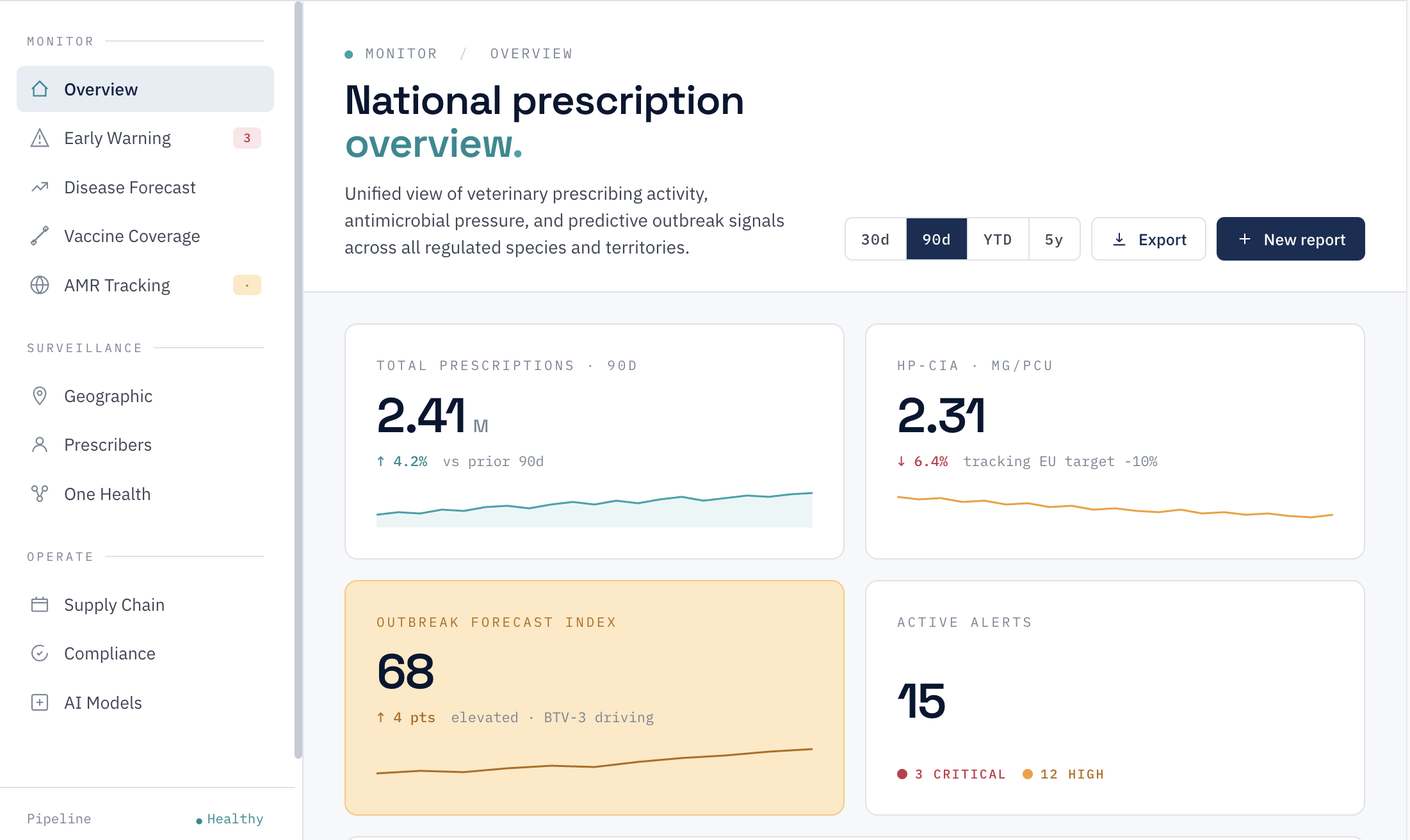
VIS turns the operational data the authority already collects into ranked, actionable risks by surfacing the emerging issues that matter, weeks before they make the news, and telling the user exactly what to do next.
Impact · in development
VIS is targeted to deliver a 4–12 week lead time on signals such as resistance shifts, supply anomalies, prescribing outliers, and emerging disease clusters, moving regulatory response from reactive to anticipatory. VIS is in active development as the roadmap evolution of the suite, not yet in production.
4–12 wk
Target lead time
Designed to surface signals weeks before they appear in conventional reporting.
4
Signal families
Resistance shifts, supply anomalies, prescribing outliers, and emerging disease clusters.
Active
Development status
In active development as the roadmap evolution of the OneAiQ suite.
Suite
Data foundation
Consumes operational data already generated by the E-Prescription System and the Medicines Lifecycle, structured for surveillance from day one.
Challenge
Regulators already sit on rich datasets, prescriptions, registries, shelter records, surveillance feeds, but turning that data into early warnings and prioritised action remains an unsolved problem in most jurisdictions. Dashboards proliferate. Decisions do not get easier. By the time a problem is visible in standard reports, it is often already a crisis.
Approach
VIS is the designed analytical layer of the OneAiQ suite, built to consume the operational data already generated by the underlying E-Prescription System and Medicines Lifecycle, and apply predictive models that surface emerging risks, rank them by impact, and attach a recommended action to each alert. The intelligence layer is feasible precisely because the data underneath it was structured for surveillance from day one (use indication, production stage, substance, region, batch) rather than retrofitted from billing systems.
01 · Analytical layer
Consumes operational data from the E-Prescription System and the Medicines Lifecycle, structured by use indication, production stage, substance, region, and batch, not retrofitted from billing systems.
02 · Predictive models
Surfaces resistance shifts, supply anomalies, prescribing outliers, and emerging disease clusters before they appear in standard reporting.
03 · Ranked by impact
Risks are ranked by impact and attached to a recommended action, moving regulatory response from reactive to anticipatory.
04 · 4–12 week lead time
Designed to deliver early warnings far enough in advance for a regulator to act, not just respond. VIS is in active development as the roadmap evolution of the suite.
Predictive value is bounded by the quality and continuity of the operational data underneath. A prescription system and a medicines lifecycle platform designed for surveillance from day one make a meaningful intelligence layer feasible, rather than aspirational. The order matters. Build the operational foundation first, and the intelligence layer follows.
More case studies
Get in touch
If your team is generating signals it doesn't have time to read, or running quarterly reports that arrive after the moment to act on them, we'd like to talk. We respond within two working days.